

Itumeleng Bahetane urges the media to embrace Africa’s indigenous languages
By Mzwandile Ndlovu
In a time of multi-media and content creators, the critical role of indigenous languages in shaping inclusive and meaningful media content was explored during a lecture at the North-West University (NWU).
Itumeleng Bahetane, South African Broadcasting Corporation (SABC) North West regional operations manager, returned to the NWU where his media journey began, to deliver a public lecture on the importance of preserving and promoting indigenous languages.
The lecture, held on 18 March at NWU’s Mahikeng Campus, was hosted by the Indigenous Language Media in Africa (ILMA) research niche area and explored producing Setswana content on Motsweding FM.
Motsweding FM is one of South Africa’s most popular Setswana-language radio stations, attracting over 3 million regular listeners across the North West, Gauteng, Free State, Limpopo, and Northern Cape. Its diverse programming of news, talk shows, music, and cultural content resonates strongly with the Setswana-speaking community, making it a key platform for promoting indigenous language content and engaging audiences in meaningful ways.
“Language is far more than a tool for communication it reflects the social, political, and economic realities of society,” said Bahetane. Referencing educational theorist Paulo Freire, he reiterated that “language is not neutral,” highlighting how linguistic structures can reinforce historical inequalities, including gender bias.
He illustrated this by pointing to examples within Setswana where certain terms are not gender-neutral, reflecting patriarchal influences embedded in the language over time. Bahetane noted that such challenges present both a responsibility and an opportunity for media practitioners.
“The platform of radio and broader media gives us a unique opportunity to create new knowledge and reshape narratives,” he said, encouraging content creators, especially postgraduate students and emerging journalists, to actively contribute to knowledge production through indigenous languages.
Bahetane cautioned that producing content in indigenous languages is complex. Direct translations often fail to capture nuanced meanings, particularly when multiple English concepts such as “energy,” “power,” and “strength” must be expressed within a single linguistic framework. “This can lead to contextual confusion if not handled carefully,” he said, stressing the need for cultural and linguistic sensitivity in news production.
Highlighting the importance of audience engagement, the guest lecturer referenced recent data from the Broadcast Research Council of South Africa, saying it showed evolving media consumption patterns in 2025 and reinforced the need for broadcasters to ensure their content resonates with diverse audiences. “You cannot operate in the content creation space without understanding whether your audience is truly engaging,” he said. “Otherwise, you are simply speaking to yourself.”
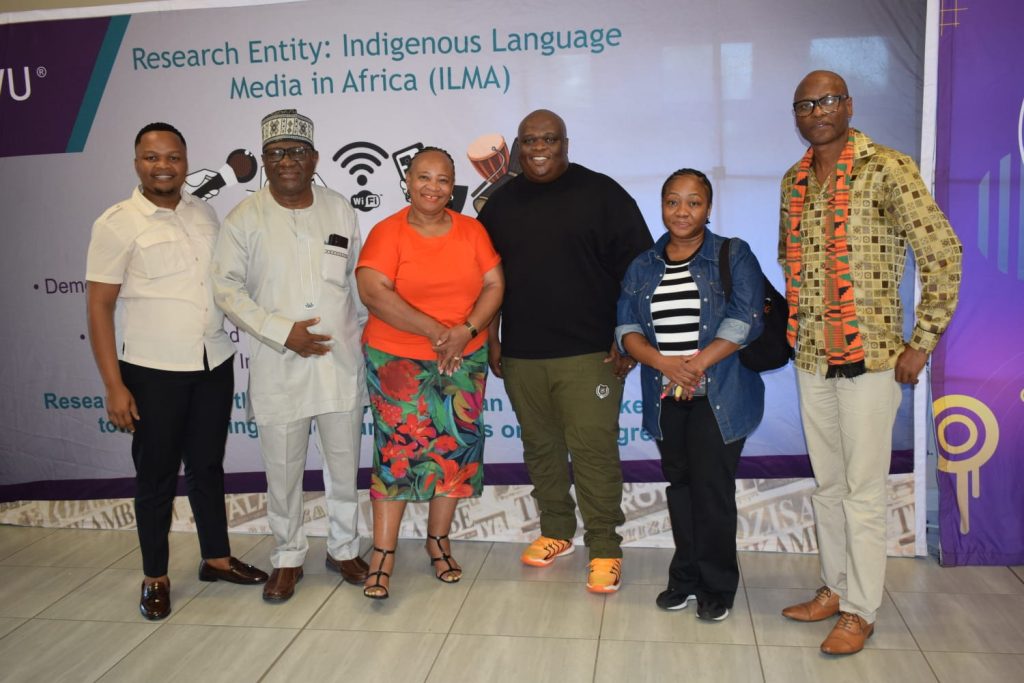
From left are Ofentse Ngake, Prof. Abiodun Salawu, Mamontha Motaung, Itumeleng Bahetane, Tsholofelo Pelo, and Prof. Gilbert Motsaathebe
He emphasised the need for media practitioners to uphold linguistic integrity, warning against the misuse of indigenous languages in commercial content. He said that, as a national radio station, Motsweding FM has a critical role to play in preserving language standards while remaining relevant to its audience, adding that they could not compromise the integrity of their languages for commercial gain.
Prof Gilbert Motsaathebe, Deputy Dean of the Faculty of Humanities, said the lecture topic was highly relevant and insightful, particularly in a time when almost everyone is a content creator.
“As we continue to develop language revitalisation theories, as well as multilingual and multicultural positioning theories, it has become increasingly clear that our indigenous languages need to be given more space on digital platforms. This is because digital platforms have become powerful tools for language revitalisation,” he said.